

Do I have sciatica?
If you've got pain shooting down your leg, there's a good chance someone has already told you it's sciatica. It's one of those terms that gets used for almost any pain below the belt line, which is part of the problem. Sciatica is real and it's common, but it's also frequently misapplied to things that aren't sciatica at all. Here's what it actually is, how it shows up, what you can do about it in the first few days, and when it's time to stop guessing and get it looked at.
What Sciatica Actually Is
Sciatica isn't a diagnosis on its own. It's a description of a symptom pattern caused by irritation or compression of the sciatic nerve, which runs from your lower back through your glute and down the back of your leg. It's the largest nerve in your body, so when something leans on it, you feel it.
The most common cause is a lumbar disc issue, usually a herniation at L4-L5 or L5-S1, where disc material pushes on a nerve root before it joins the sciatic nerve. Other causes include spinal stenosis, degenerative changes in the spine, and occasionally piriformis muscle irritation, where the muscle deep in the glute compresses the nerve as it passes through or near it.
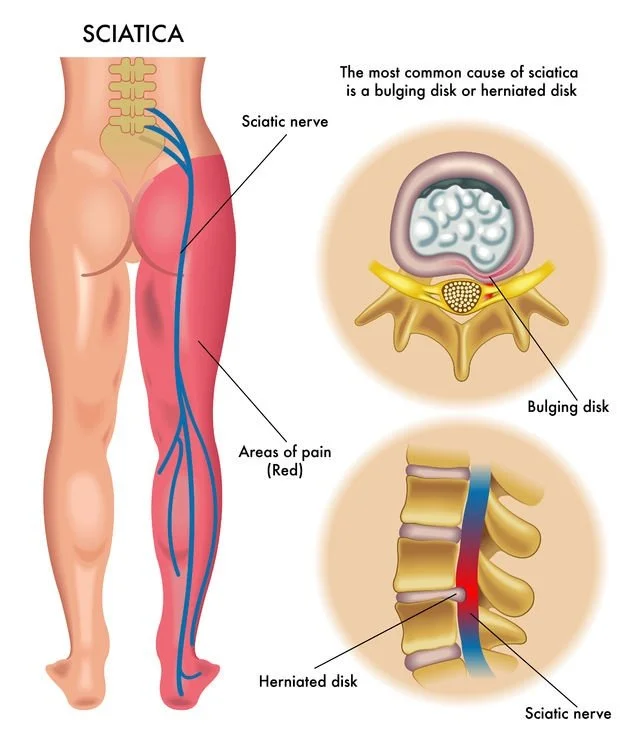
How It Presents
True sciatica has a fairly recognizable pattern:
Pain that starts in the low back or glute and travels down the back or side of the leg, often past the knee and sometimes into the foot
The leg pain is often worse than the back pain, which surprises people
Numbness, tingling, or a burning quality along that path
Weakness in the leg or foot in more significant cases, like trouble lifting the front of your foot
Symptoms that worsen with sitting, bending forward, or coughing and sneezing, since these all increase pressure on the disc
Usually one-sided
Where people get tripped up is assuming any leg pain, hip pain, or glute pain is sciatica. A lot of things mimic it. Hip joint pathology, SI joint dysfunction, hamstring tendinopathy, and referred pain from the low back without actual nerve involvement can all feel similar on the surface. This matters because the treatment for each of these is different, and treating a hip problem like it's a nerve problem (or vice versa) can waste weeks of your time.
Self-Treatment for Acute Cases
If your symptoms are new, mild to moderate, and you have no red flags (more on those below), here's what tends to help in the first one to two weeks:
Stay active within tolerance. Bed rest actually slows recovery. Movement, even if it's just gentle walking, keeps things from stiffening up further.
Avoid prolonged sitting. Sitting loads the disc more than standing or walking. Break up sitting every 20-30 minutes if you can.
Try directional preference exercises. Many people with disc-related sciatica get relief from repeated extension movements, like prone press-ups (lying on your stomach and pressing your upper body up while keeping your hips down). This isn't universal, though. Some people feel better with flexion-based movement instead. The key sign to watch for is centralization, meaning the pain retreats back toward your spine and away from your foot as you move. That's a good sign. If leg symptoms get worse or travel further down the leg, stop that movement.
Manage pain with basics. Ice or heat, whichever feels better to you, and over-the-counter anti-inflammatories if you tolerate them, can take the edge off while your body settles down.
Avoid heavy lifting, twisting, and bending under load until symptoms calm down.
Most acute episodes improve significantly within a few weeks with this kind of approach. If you're not seeing any improvement, or things are getting worse, that's your signal to move on to the next step.

When to See a PT
You don't need to wait until it's unbearable. A good rule of thumb: if sciatica-type symptoms are getting in the way of your normal daily life, whether that's sleep, work, exercise, or basic movement, it's worth being evaluated rather than guessing at home indefinitely.
See a PT sooner rather than later if:
Symptoms have lasted more than two weeks without improvement
Pain is severe or rapidly worsening
You're noticing weakness, not just pain, especially in your foot or ankle
Symptoms are affecting your sleep or your ability to work
You've had a prior episode and want a plan to keep it from becoming a recurring pattern
A PT can properly differentiate true nerve-related sciatica from the conditions that mimic it, build a movement-based plan specific to what's actually driving your symptoms, and help you avoid the trial-and-error approach that often leads people to just tolerate pain for way longer than necessary.
Seek care urgently, not just PT care but medical evaluation, if you experience: loss of bowel or bladder control, numbness in the groin or inner thighs (saddle anesthesia), or rapidly progressing leg weakness. These are signs of a more serious nerve compression and need prompt medical attention.
The Bottom Line
Sciatica is a pattern, not a catch-all label, and plenty of conditions can look like it without being it. A short course of self-care is reasonable for a new, mild episode. But once it starts interfering with your everyday life, or if it's not improving in a couple of weeks, that's the point to get an actual evaluation rather than keep guessing. Getting the right diagnosis early is usually what separates a quick recovery from a long, frustrating one. If you are seeking treatment for sciatica and are located in Old Town Alexandria, please book a discovery call so we can go over your treatment options.